What Does Canine Fitness Involve?
Fitness for dogs involves more than simply adding extra activity to the day. A thoughtful approach considers how a dog moves and stays balanced. It also looks at how the dog learns skills and interacts with people and its environment. Activities should also be appropriate for the individual dog’s physical condition and abilities.
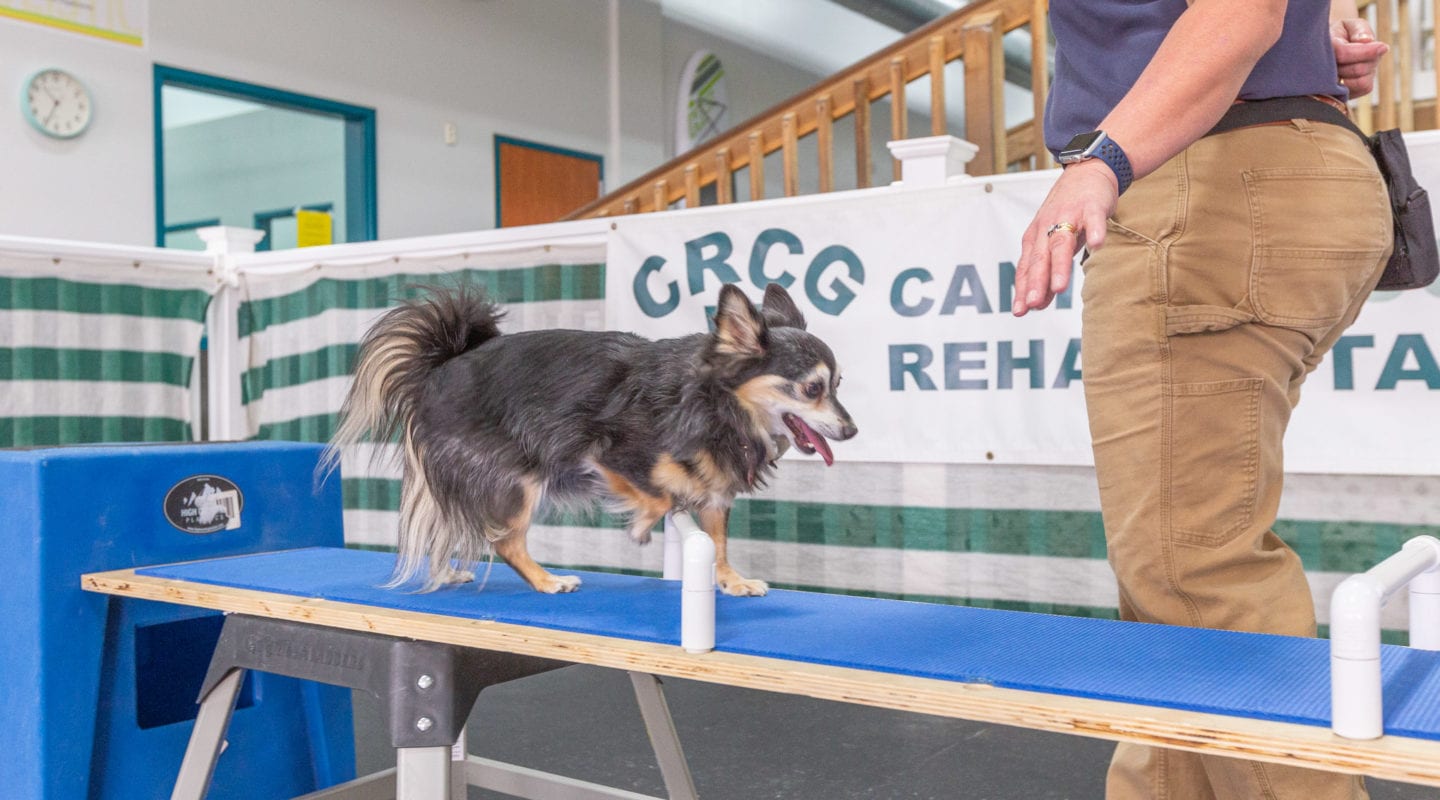
Our TOTAL DOG program approaches canine health and fitness through three connected elements: Balance, Body, and Bonding. Balance and Body skills are built using F.I.T. (Fitness Integrated Training), our structured method of pairing a small set of tools, including FitPAWS balance equipment, with hundreds of possible exercises targeting one or several areas of the body at a time. Bonding comes from helping people better understand how their dog moves, learn, and view their environment. These elements are brought together to strengthen the connection between dogs and their people.
This type of structured activity can give owners a clearer purpose when engaging in physical activities with their dogs. Instead of focusing only on how much exercise a dog receives, fitness activities can also emphasize the quality of movement, learned skills, balance, and engagement.
TOTAL DOG I & II: A Progressive Fitness Curriculum
Rather than one generic class, TOTAL DOG is built as a progression. TOTAL DOG I focuses on the fundamentals: forelimb awareness through placement work, rear limb awareness through pivoting and lateral movement, static and dynamic balance, an introduction to moving toward and away from the handler, and proper stationary posture (sit, down, stand, wait).
TOTAL DOG II builds on that foundation: rear limb awareness becomes a primary skill (including backward walking and elevated rearlimb work), forelimb awareness is strengthened through turn-on-haunches and lateral movement, and the focus shifts to gait training, endurance, changing speed and stride length within a gait, and using changes of direction as a dynamic balance skill.
For younger dogs, TOTAL PUPPY introduces overall body awareness, handling skills, and variable-surface training in an age-appropriate way, building confidence and proper posture before a puppy is ready for TOTAL DOG I. And for dogs and owners who want to add a mental outlet alongside the physical work, TOTAL NOSE introduces scent detection basics — search patterns and alerts — layered on top of a dog’s fitness training.
Understanding How Your Dog Moves
Before recommending a specific fitness path, it helps to understand how a dog is actually moving. We offer gait analysis using the GAIT4Dog Analysis System, a sensor walkway that objectively measures individual paw strikes, limb loading, and movement restrictions, rather than relying on visual observation alone. Findings can help our team recommend which combination of TOTAL DOG classes, one-on-one coaching, or conditioning work fits an individual dog, whether the goal is general fitness, sport and show conditioning, or simply a clearer picture of how a dog moves day to day. Learn more about gait analysis
Balance Is Built Into Everything We Do
Balance plays a central role in the TOTAL DOG approach, dogs use it as they move, change direction, negotiate different surfaces, and perform learned behaviors, and our F.I.T. method progresses each dog from easier to more demanding equipment as balance and body awareness improve. See how our dedicated balance training works
Its core focus can be summarized as:
• Balance: Developing static and dynamic balance through structured activities and progressively challenging equipment.
• Body: Building strength, body awareness, and skills — from foundational placement and posture work through advanced gait, endurance, and direction-change training. More on strength & conditioning →
• Bonding: Helping people understand their dogs and strengthening the relationship between them.
This combination creates an approach in which physical activity and interaction are closely connected.
Why Functional Exercise Matters for Sport and Active Dogs
Dogs involved in agility, disc dog, dock diving, flyball, herding trials, lure coursing, weight pulling, ring sport, or any other demanding activity benefit from exercises built around functional movement — exercises designed to mirror what a dog’s body actually does in competition, rather than generic conditioning. Functional exercise increases body awareness, targets the specific muscle groups used in performance, and reduces the chance of injury — and if an injury does happen, a dog with better body awareness and conditioning typically has an easier recovery.
As dogs advance through the levels of their sport, the physical demands become progressively greater. Our F.I.T. approach is designed to match that progression, moving dogs through increasingly demanding exercises and equipment as their skills develop — the same progressive philosophy we use in clinical rehabilitation, just applied to a healthy, active dog instead of a recovering one.
One-on-One Fitness Coaching
For owners who want an individualized plan, our one-on-one coaching is driven by the client’s goals and their dog’s specific needs. A TD Assessment begins with a review of current activity level, home environment, and diet, along with a discussion of the owner’s goals. We then perform a full movement assessment — conformation at a stand, sit, and down; gait at a walk, trot, and gallop; transitions between stationary positions and gait; locomotion including backward and side-stepping movement; balance and body awareness; and how the dog responds to the handler’s movement — recorded with photo and video to establish a baseline. Clients leave with a clearer picture of their dog’s current fitness and skill level, and a written fitness & conditioning plan and training plan for both the short and long term.
Ongoing coaching sessions start with a quick review of the past week, then move through a warm-up, exercises (progressing from static to dynamic), training skills work, a F.I.T. circuit, and a cool-down. Clients go home with an updated home exercise plan and goals for the following week — often supported by our F.I.T. Cards & Circuit Maps, available in hard copy or digital form, so the work continues between sessions.
Recreational Swimming Offers Another Way to Exercise
For dogs that enjoy water, recreational swimming provides a different form of physical activity. Canine Rehabilitation & Conditioning Group offers recreational swimming for healthy dogs at our Englewood and Broomfield locations. Both facilities have heated, freshwater indoor pools that are available year-round, with open swim and reserved private swim options.
Pool size and setup vary by clinic. Check our locations for that clinic’s specific pool dimensions and details (and check back here as we add pools at future locations). Across our facilities, dogs have space to swim, fetch, and move through the water, and life vests are available for dogs that are learning to swim or need additional support.
First-time swimmers complete an orientation. During that introduction, staff helps the dog become familiar with the facility, water, and pool ramp. Once a dog is comfortable entering and exiting the pool independently, owners can choose suitable recreational pool sessions based on current availability, policies, and scheduling requirements.
Is Recreational Swimming Appropriate for Every Dog?
Recreational swimming is specifically intended for healthy dogs. Dogs with lameness, weakness, recent surgery, mobility concerns, or other physical issues may need an assessment before using the recreational pool. The website also specifies that post-surgical dogs and dogs weakened by injury or age require physical therapist clearance before recreational pool use.
This distinction matters because recreational exercise and clinical care serve different purposes. A healthy dog looking for enjoyable activity has different needs from a dog recovering from surgery or experiencing neurological, orthopedic, or mobility challenges.
If you are unsure whether swimming is suitable for your dog, contacting our team before scheduling recreational pool time is the appropriate next step. We can help determine whether recreational swimming is an option or whether your dog should first be evaluated through our clinical services.
Understanding Fitness Versus Canine Rehabilitation
General fitness should not be confused with canine rehabilitation. Fitness activities, including our fitness classes, balance training, gait analysis, and strength & conditioning work, are suitable for healthy dogs or those working toward specific conditioning goals, whereas rehabilitation provides clinical care for animals with health or functional concerns.
Our clinical services are designed for geriatric, injured, overweight, post-operative, neurologic, and otherwise compromised dogs. Clinical rehabilitation begins with an evaluation by a veterinarian or physical therapist. The evaluation includes orthopedic, neurologic, and myofascial examination, and the resulting plan can include in-clinic recommendations and home exercises based on the individual dog’s condition.
Certified rehabilitation therapists also provide strength & conditioning support for sport and show dogs. Professional guidance can help distinguish between general conditioning and rehabilitation when a dog has medical concerns, is recovering from an injury or surgery, or is training for sport or show activities.
For owners, the key distinction is that general fitness and rehabilitation serve different purposes. Dogs with injuries, mobility concerns, recent surgery, or other health issues may need professional evaluation before participating in recreational exercise.
Finding the Right Type of Activity for Your Dog
Dogs differ in age, physical condition, confidence, experience, and enthusiasm for particular activities. Some dogs may enjoy swimming immediately, while others need time to become comfortable in the water. The company’s recreational swim orientation recognizes these differences and helps first-time swimmers learn how to use the pool ramp and enter and exit safely. Some dogs may ultimately prefer other forms of exercise.
When considering fitness activities, owners can think about several practical questions:
• Is my dog currently healthy and comfortable with regular activity?
• Does my dog enjoy water or prefer land-based activities?
• Would structured balance training or canine fitness classes be a better fit?
• Would my dog benefit from a gait analysis to better understand how they move?
• Am I interested in an activity that involves learning alongside my dog?
• Does my dog have an injury, recent surgery, weakness, or mobility concern that should be professionally evaluated first?
These questions help distinguish between recreational exercise, structured fitness classes, and clinical rehabilitation without assuming that one option is appropriate for every dog.
Fitness Can Include the Human-Dog Connection
TOTAL DOG Fitness approaches canine fitness as more than physical movement alone. Understanding how dogs perceive their surroundings and developing training skills are also incorporated into the program.
The program’s Balance, Body, and Bonding framework recognizes that owners are part of the experience. As dogs work on skills and balance, people also learn more about how their dogs respond to their environment. That shared participation supports the bond between dog and person, which is a stated goal of TOTAL DOG.
This approach can make fitness time purposeful without reducing it to repetitive exercise. The emphasis is on developing skills and balance while giving dogs and their people something they can work on together.
Choose a Fitness Option That Fits Your Dog
At Canine Rehabilitation & Conditioning Group, we recognize that canine activity can take different forms depending on the dog. Our canine fitness classes, gait analysis, balance training, and strength & conditioning programs provide structured activities focused on Balance, Body, and Bonding, while our indoor recreational pools allow healthy dogs to swim for fun or exercise. Dogs with injuries, recent surgery, mobility limitations, or other health concerns may require an appropriate evaluation before participating in general fitness activities. Our team can help owners understand the available services and determine an appropriate next step for their dogs.
Ready to explore canine fitness with your dog? Contact us today to learn more about fitness classes, gait analysis, balance training, strength & conditioning, recreational swimming, or the appropriate next step for your companion.