What Is Canine Gait Analysis?
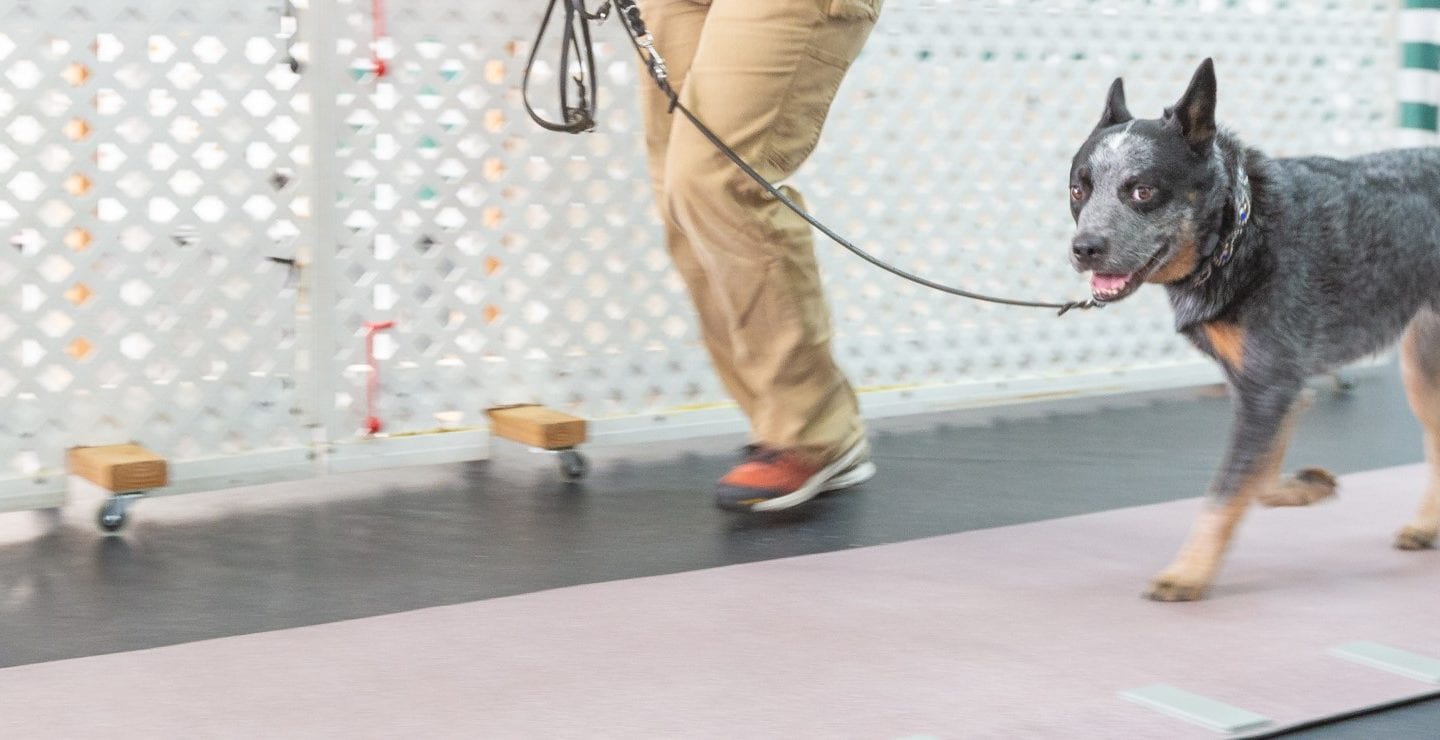
Gait refers to the pattern of a dog’s foot strikes against the ground during movement. Although dogs most often move forward, movement can also occur backward and from side to side. A gait analysis examines these movement patterns to provide more detailed information about how the dog is using its limbs.
Visual observation remains valuable, but subtle differences in movement may not always be apparent to an untrained eye. An objective gait assessment adds measurable information that can help identify signs of lameness and establish a clearer picture of how a dog moves.
Rather than looking only at how a dog appears while standing still, gait analysis evaluates the dog in motion. This distinction matters because movement shows how the limbs function as the dog walks and transfers weight from one paw to another.
How the GAIT4Dog Analysis System Works
Our gait analysis uses the GAIT4Dog Analysis System, which incorporates a sensor walkway and GAITFour proprietary software. As a dog moves across the walkway, sensor data records its paw strikes. The software automatically identifies the individual paw and determines which limb is associated with each strike.
The system assesses several aspects of movement, including:
- Limb placement during movement
- Loading and off-loading of the limbs
- Restrictions in movement
- Paw-specific and limb-specific values
- The degree of lameness by limb
- Identifies the compensating limb
GAITFour software also calculates multiple parameters to quantify the recorded gait. One of these measurements is the GAIT4Dog Lameness Score, or GLS, which is designed to present information in a format that owners and clinicians can understand.
These measurements provide information that goes beyond simply describing a dog as moving normally or abnormally. They offer a structured way to evaluate differences among individual limbs.
Why Assessing a Dog in Motion Matters
Lameness does not always present as an obvious limp. Differences in how a dog places a paw, loads a limb, or compensates with another limb may provide additional information about its movement.
The GAIT4Dog system assigns each limb a score relative to 100 and provides individual measurements for each paw and limb. It is designed to show primary and secondary lameness, quantify the degree of lameness by limb, and identify a compensating limb.
Compensation is particularly relevant when evaluating movement because a dog may change how it uses other limbs when one area is affected. Identifying these patterns gives clinicians additional objective information to consider alongside the broader clinical picture. Gait data should be viewed within the appropriate veterinary or rehabilitation context rather than as a substitute for professional clinical assessment.
Using Gait Analysis to Monitor Treatment
A single movement assessment can provide useful baseline information, while gait analysis can also help track changes throughout treatment. Canine Rehabilitation & Conditioning Group uses the system to provide measurable information that can be compared as treatment progresses.
Objective measurements can be particularly useful because visual impressions alone may not capture every change in limb use. Recorded gait parameters provide another source of information for evaluating movement over time.
The GAITFour system can generate reports from the recorded assessment. These reports can be saved as PDFs or emailed directly to the owner or referring clinician. Appropriate videos can also be included. This reporting capability helps make movement information available to the people involved in the dog’s care.
Understanding Lameness and Compensation
Lameness describes an alteration in normal movement that can occur for many reasons. Because determining the underlying cause requires appropriate professional evaluation, owners should avoid interpreting a change in gait as confirmation of a specific condition.
Gait analysis provides measurable information about movement patterns. For example, the system can quantify lameness in individual limbs and identify which limb is compensating.
This distinction is important. Objective movement data provides information about how a dog is moving. That information can then be considered as part of the broader evaluation and care process.
Owners who notice a change in their dog’s movement should discuss their concerns with an appropriate veterinary professional rather than trying to determine the cause from observation alone.
Gait Analysis as Part of Collaborative Canine Care
Movement does not exist separately from a dog’s overall physical function. Rehabilitation professionals may consider gait alongside range of motion, weight-bearing ability, muscle condition, joint function, and other factors when evaluating a dog’s mobility and physical function.
Our broader rehabilitation approach involves a collaborative team that includes veterinarians, physical therapists, and licensed veterinary technicians. We also work with referring veterinarians and, when needed, other animal health professionals to assess and support mobility and physical function.
Within this broader context, objective gait information can provide measurable data for evaluating movement patterns. Reports and appropriate videos can also be shared with a referring clinician to provide clear information about the dog’s gait findings.
What Can Owners Learn From a Gait Analysis?
One challenge for dog owners is that subtle changes in a dog’s movement can be difficult to notice at home. Dogs also use their entire bodies to move, which means a change affecting one limb may influence how other limbs are used.
A gait analysis translates movement into measurable information. Instead of relying exclusively on whether a dog appears to limp, owners and clinicians can review data associated with individual paws and limbs.
The resulting information may help answer questions such as:
- Is there a measurable difference between limbs?
- Which limb shows the greatest degree of lameness?
- Is another limb compensating?
- How is each limb being loaded and off-loaded?
- Has the recorded gait changed during treatment?
These questions focus on observable and measurable movement rather than asking owners to diagnose the cause themselves.
Connecting Movement Assessment With Canine Rehabilitation
Canine rehabilitation focuses on physical function and may involve goals related to mobility, range of motion, movement, strength, and everyday activity. An objective assessment of gait can complement this work by providing quantifiable information about the way a dog moves.
This information provides professionals with documented gait measurements that can supplement visual observation. Because the system generates reports, findings can also become part of the information available when reviewing treatment progression.
The appropriate role of gait analysis will depend on the individual dog and the specific reason for assessing its movement. How gait analysis is used can depend on the individual dog and the reason its movement is being evaluated.
A Measurable Approach to Understanding Canine Movement
Dogs cannot explain when a movement feels different, and subtle gait changes may be difficult for owners to recognize. Objective analysis provides another way to examine what happens when a dog is actually in motion.
At Canine Rehabilitation & Conditioning Group, our GAIT4Dog system evaluates paw and limb data, quantifies lameness, identifies compensating limbs, and produces reports for clients and referring clinicians to review. When considered alongside appropriate professional evaluation, this information provides a detailed way to understand a dog’s movement better and monitor changes during treatment.
Contact us today to learn more about gait analysis and how objective movement assessment may provide useful information about your dog’s gait.